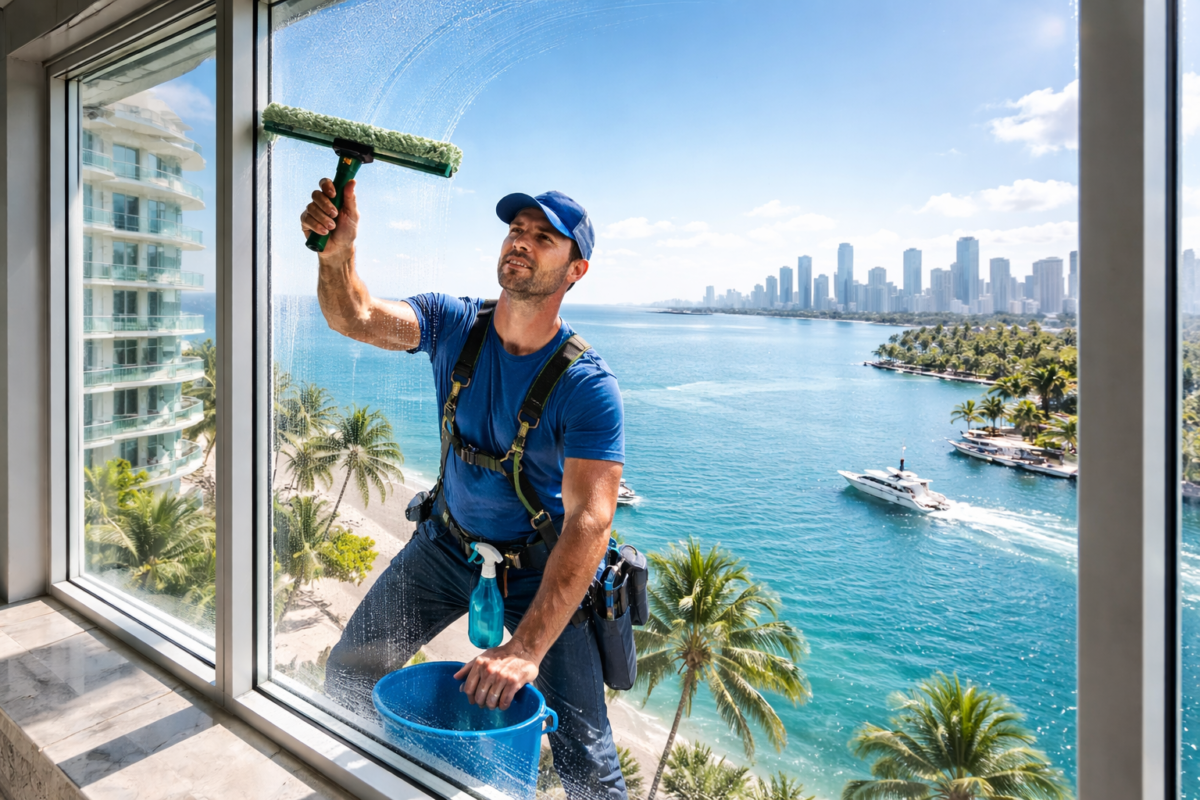
Window cleaning in Miami is not as straightforward as it seems. Coastal salt, hard water stains, strong sun, humidity, and a high number of condos and multi-story buildings all create challenges that are easy to underestimate. Homeowners and property managers often rely on trial and error, which can lead to wasted time, poor results, or even safety risks.
This comprehensive guide brings together 15 essential window cleaning resources for Miami, grouped by cost, education, service comparison, neighborhood considerations, and problem-solving. The goal is simple: help you make informed decisions using practical information that actually applies to living and working in Miami’s unique coastal environment.
Blog Overview
Window cleaning in Miami comes with challenges that many homeowners and property managers don’t expect. Coastal salt, hard water stains, humidity, and multi-story buildings all affect how windows should be cleaned and maintained. According to the International Window Cleaning Association, improper window cleaning techniques can cause permanent damage to glass and frames, making professional knowledge essential.
This guide brings together essential resources that help explain costs, timing, service differences, neighborhood considerations, and common window problems. Instead of relying on guesswork, these resources are meant to help you make informed decisions about window cleaning in Miami. Whether you’re comparing services, trying to understand pricing, or deciding when to stop DIY efforts, this guide gives you a clearer place to start.
Key Takeaways
| Resource Area | What It Helps You Understand | Why It Matters in Miami |
|---|---|---|
| Cost benchmarks | Typical window cleaning pricing | Avoids overpaying or risky low quotes |
| Pricing methods | Pane-based and access-based pricing | Makes estimates easier to compare |
| Seasonal timing | Best times to clean windows | Reduces streaks and improves results |
| DIY basics | What you can safely do yourself | Prevents damage and injury |
| Tool limitations | Why household tools fall short | Explains professional-level results |
| Service differences | Residential vs commercial needs | Sets proper expectations |
| High-rise cleaning | Safety and equipment requirements | Essential for condos and tall buildings |
| Coastal properties | Salt exposure effects | Protects glass and frames |
| Problem stains | Hard water and mildew issues | Prevents long-term damage |
| Professional timing | When to call experts | Saves time and frustration |
How Much Window Cleaning Costs in Miami and Why
1. Miami Window Cleaning Cost Benchmarks
One of the most useful resources is understanding typical window cleaning costs in Miami. Professional window cleaning nationally ranges from $150 to $450 for an average home, but Miami’s unique conditions often affect pricing.
Most residential homes fall within a general price range, while larger or more complex properties require custom pricing. Costs usually depend on the number of windows, accessibility, and whether the property is single-story or multi-story. Having a realistic benchmark helps homeowners avoid both overpaying and choosing unusually low quotes that may come with risks.
Key pricing factors in Miami include:
- Number of glass panes (not just “windows”)
- Building height and accessibility
- Coastal salt buildup requiring specialized cleaning
- Hard water stain treatment needs
- Screen removal and cleaning
- Frequency of service (one-time vs. recurring)
2. How Professional Window Cleaning Is Priced
Window cleaning in Miami is commonly priced by counting glass panes rather than windows. A single window may count as one pane, while larger windows with multiple sections count as more. Understanding this distinction prevents confusion when comparing quotes.
Other pricing factors include screens, hard-to-reach areas, and safety requirements. Properties requiring ladder work, scaffolding, or rope access will naturally cost more due to equipment and insurance needs. Understanding how pricing works makes estimates easier to compare and less confusing.
Common pricing models:
- Per pane pricing: $4-$12 per pane depending on size and accessibility
- Per window pricing: $5-$15 per standard window unit
- Hourly rates: $50-$100 per hour for complex jobs
- Flat rate packages: Common for recurring residential services
3. When to Expect Custom Quotes
Flat pricing doesn’t apply to every property. High-rise buildings, waterfront homes, and commercial properties usually require custom quotes.
These properties involve additional planning, equipment, and safety considerations. The Occupational Safety and Health Administration (OSHA) has strict requirements for working at heights, which affects both equipment needs and labor costs. Expecting a custom estimate in these cases is normal and often a sign of professionalism.
Window Cleaning Basics Every Miami Homeowner Should Know
4. Best Time of Year to Clean Windows in Miami
While windows can be cleaned year-round, winter is often one of the best times in Miami. Cooler temperatures (December through February) reduce streaking, and softer light makes dirt and buildup easier to spot.
According to meteorological data, Miami’s winter months have lower humidity levels (averaging 65-70% vs. 75-80% in summer), which means cleaning solutions dry more evenly and streak-free results are easier to achieve.
Best cleaning schedule for Miami:
- Winter (Dec-Feb): Ideal for deep cleaning – low humidity, comfortable temperatures
- Spring (Mar-May): Good for maintenance cleaning before summer storms
- Summer (Jun-Aug): Requires early morning cleaning to avoid heat streaking
- Fall (Sep-Nov): Post-hurricane season assessment and cleaning
Understanding seasonal timing helps homeowners schedule cleaning when results are more effective and longer-lasting. Consider creating a window cleaning checklist for Miami homeowners to stay on track.
5. Safe DIY Window Cleaning Basics
There are some window cleaning tasks homeowners can handle themselves. Interior glass, easily reachable exterior windows, and light dusting are usually manageable. However, the Consumer Product Safety Commission reports that ladder-related injuries send over 500,000 people to emergency rooms annually.
Anything involving ladders, upper floors, or chemical buildup should be approached with caution. Knowing where DIY ends helps prevent accidents and damage.
Safe DIY parameters:
- Ground floor windows only
- Windows accessible without ladders
- Light dirt and dust removal
- Basic interior cleaning
- No chemical stain removal
Leave to professionals:
- Second story and higher
- Hard water stain removal
- Salt buildup treatment
- Any work requiring ladders above 6 feet
- Mold and mildew remediation around frames
6. Tools That Actually Make a Difference
Household paper towels and spray cleaners often lead to streaks and lint. Professional window cleaners rely on proper squeegees and microfiber tools because they remove water evenly and leave less residue.
According to industry standards, professional-grade squeegees with replaceable rubber blades remove 99.9% of water in a single pass, while paper towels and household cloths can leave behind fibers, residue, and streaking. Understanding the limitations of basic tools explains why professional results often look noticeably better.
Professional tools vs. household items:
| Tool Type | Household Version | Professional Version | Why It Matters |
|---|---|---|---|
| Squeegee | Plastic, fixed blade | Brass channel, replaceable rubber | Even water removal, no streaks |
| Cleaning cloth | Paper towels, cotton rags | Microfiber, surgical huck | No lint, superior absorption |
| Extension pole | Broom handle, mop stick | Telescopic professional pole | Reach without ladders, stability |
| Cleaning solution | Blue window spray | pH-balanced professional formula | Cuts salt/minerals, no residue |
| Scrubber | Kitchen sponge | Strip washer/sleeve | Agitates dirt safely, even coverage |
Residential vs Commercial vs High-Rise Window Cleaning
7. Residential vs Commercial Window Cleaning
Residential window cleaning focuses on appearance and home comfort. Commercial window cleaning often has stricter standards and recurring schedules to maintain a professional image.
Key differences:
| Aspect | Residential | Commercial |
|---|---|---|
| Frequency | 1-4 times per year | Weekly to monthly |
| Timing | Flexible scheduling | Off-hours to avoid disruption |
| Standards | Homeowner preference | Building code compliance |
| Insurance | General liability | Higher limits, bonding required |
| Equipment | Basic to moderate | Specialized commercial-grade |
| Contract type | One-time or seasonal | Long-term service agreements |
Knowing the difference helps property owners choose services that match their needs rather than assuming all window cleaning is the same.
8. High-Rise Window Cleaning vs Standard Services
High-rise window cleaning requires specialized training, equipment, and safety protocols. Not every window cleaning company offers this service. According to OSHA regulations, work above 4 feet requires fall protection, and work above 6 feet requires specific safety systems.
For condos and taller buildings, understanding this difference is essential for safety and compliance. High-rise cleaning may involve:
- Rope access (SPRAT/IRATA certified technicians)
- Swing stages and scaffolding
- Building maintenance units (BMUs)
- Water-fed pole systems for mid-rise buildings
- Comprehensive insurance and liability coverage
Read about high-rise window cleaning safety measures, safety considerations when hiring a window cleaner, and what you need to know for high-rise window cleaning.
9. DIY Window Cleaning vs Professional Services
DIY cleaning can work for small jobs, but it requires time, effort, and consistency. Professional window cleaning offers efficiency, safety, and reliable results.
Research from the National Safety Council indicates that ladder falls are the leading cause of home improvement injuries. Comparing DIY versus professional services helps homeowners decide when convenience and long-term care outweigh the effort of doing it themselves.
Comprehensive comparison:
| Factor | DIY | Professional |
|---|---|---|
| Time investment | 2-6 hours for average home | 1-2 hours with crew |
| Safety risk | High (ladders, heights) | Minimal (trained, insured) |
| Streak-free results | Difficult to achieve | Guaranteed |
| Equipment cost | $50-200 initial | Included in service |
| Hard water removal | Usually ineffective | Specialized treatments available |
| Frequency maintained | Often skipped | Scheduled automatically |
How Window Cleaning Changes by Home Type and Location
10. Window Cleaning for Coastal and Waterfront Properties
Salt residue is one of the biggest challenges for Miami properties near the ocean or intracoastal areas. According to coastal building research, salt spray can travel up to 10 miles inland, affecting windows throughout Miami-Dade and Broward counties.
Salt buildup reduces clarity and can wear down glass and frames faster. The calcium and sodium chloride in ocean spray create a film that attracts dirt and accelerates oxidation of metal window components. Regular cleaning is especially important in these neighborhoods to protect windows over time.
Coastal window challenges:
- Salt film buildup requiring acidic cleaning solutions
- Accelerated corrosion of metal frames and hardware
- Mineral deposits from sea spray
- Higher cleaning frequency needed (every 1-2 months vs. 3-4 months inland)
- UV damage amplified by salt crystal reflection
11. Condo and Apartment Window Cleaning Considerations
Condos often come with access limitations and building rules. Exterior window cleaning may require coordination with management or approved vendors. Many high-rise condominiums have insurance requirements that only allow certified, bonded companies to work on the building exterior.
Understanding these restrictions helps residents plan services without delays or complications. Common condo considerations include:
- Building management approval required
- Restricted service hours
- Approved vendor lists
- Proof of insurance requirements ($1M+ liability typical)
- Interior-only cleaning for individual units
- Building-wide exterior cleaning schedules
Important questions for condo owners:
- Does your building allow individual window cleaning services?
- What insurance documentation is required?
- Are there specific vendors you must use?
- What access restrictions apply to balconies?
- Who is responsible for exterior glass cleaning?
12. Single-Family Homes vs Multi-Story Homes
Single-story homes are usually simpler to clean. Multi-story homes involve higher windows and greater safety risks. The difference in complexity affects both pricing and the level of expertise required.
Comparison breakdown:
| Property Type | Average Window Count | Typical Service Time | Risk Level | Price Range |
|---|---|---|---|---|
| Single-story ranch | 15-25 windows | 1-2 hours | Low | $150-$250 |
| Two-story home | 25-40 windows | 2-3 hours | Moderate | $250-$400 |
| Three-story home | 40-60+ windows | 3-5 hours | High | $400-$700+ |
| Waterfront mansion | 60-100+ windows | Full day | Very high | $700-$1,500+ |
Knowing how property type affects pricing and approach helps homeowners set realistic expectations and budget appropriately.
How to Deal With Stains, Mold, and Buildup
13. Removing Hard Water Stains in Miami
Hard water stains are common due to sprinkler systems and mineral-rich water. According to the U.S. Geological Survey, South Florida has some of the hardest water in the United States, with mineral content often exceeding 180 mg/L.
These stains don’t disappear with basic wiping. The minerals (primarily calcium and magnesium) bond to glass at a molecular level. Early treatment is important because over time, minerals can etch into the glass and reduce clarity permanently, a condition called “glass degradation” that cannot be reversed.
Hard water stain progression:
- Stage 1 (0-3 months): Surface mineral film – removable with acidic cleaners
- Stage 2 (3-12 months): Bonded mineral deposits – requires professional treatment
- Stage 3 (12+ months): Glass etching – permanent damage, may require replacement
Professional treatment options:
- Acidic cleaning solutions (vinegar-based or commercial)
- Fine abrasive compounds (cerium oxide)
- Diamond-impregnated pads for severe cases
- Preventive coatings to resist future buildup
14. Dealing With Mold and Mildew Around Windows
Miami humidity can cause mold and mildew to form around window frames and tracks. According to the EPA’s mold prevention guidelines, mold can grow wherever moisture is present for 24-48 hours, making Miami’s climate particularly challenging.
This affects both appearance and indoor comfort. The CDC indicates that mold exposure can trigger respiratory issues, allergic reactions, and asthma symptoms, particularly in sensitive individuals.
Cleaning glass alone doesn’t solve the problem. Frames, tracks, sills, and surrounding areas also need attention. Common mold locations include:
- Window tracks and drainage channels
- Weatherstripping and gaskets
- Wooden frames (especially in older homes)
- Caulking and sealant joints
- Areas where condensation regularly forms
Prevention strategies:
- Reduce indoor humidity below 60%
- Ensure proper window drainage
- Regular cleaning of tracks and frames
- Fix leaks and condensation issues promptly
- Consider dehumidification in high-risk areas
15. Knowing When to Call Professionals
There is a point where DIY cleaning no longer makes sense. Persistent stains, hard-to-reach windows, safety concerns, and time constraints are all signs that professional help is the better option.
Clear indicators it’s time to hire professionals:
- Safety concerns: Second-story windows, ladder requirements, heights that cause discomfort
- Stain persistence: Hard water or salt buildup that won’t respond to household cleaners
- Time constraints: Cleaning would take your entire weekend
- Recurring problems: Streaks, mildew, or stains that keep returning
- Special glass: Tinted, coated, or historic windows requiring specific care
- Preparation for sale: Home listing or showing requiring impeccable appearance
- Post-construction: New construction or renovation requiring specialized cleaning
- Equipment limitations: Lack of proper tools for streak-free results
How to Choose the Right Window Cleaning Service
Questions to Ask Before Hiring
Before hiring any window cleaning service in Miami, ensure you’re working with qualified professionals. Consider these 9 questions to ask before hiring a window cleaner:
- Are you licensed and insured? (General liability and workers’ compensation)
- How long have you been serving Miami? (Local experience matters)
- What cleaning methods do you use? (Traditional, water-fed pole, etc.)
- Do you guarantee your work? (Satisfaction policies)
- What is included in your service? (Screens, tracks, frames)
- How do you handle hard water stains? (Treatment capabilities)
- Can you provide local references? (Verifiable past work)
- What safety protocols do you follow? (OSHA compliance)
- Do you offer maintenance programs? (Regular service discounts)
Conclusion
Window cleaning in Miami comes with unique challenges that require better information and smarter planning. From understanding pricing and seasonal timing to knowing when DIY becomes unsafe, having the right resources makes all the difference.
This guide has covered 15 essential resources spanning:
- Cost and pricing transparency to help you budget appropriately
- Educational fundamentals about timing, tools, and techniques
- Service comparisons to match your property type and needs
- Location-specific considerations for Miami’s coastal environment
- Problem-solving guidance for stains, mold, and when to seek help
If you want professional support tailored to Miami homes, condos, and buildings, Klean Windows Miami offers reliable window cleaning services designed for local conditions. With experience serving neighborhoods from Coral Gables to Miami Beach, from Brickell to Key Biscayne, we understand the specific challenges each area presents.
Contact us today to request a free estimate and take the guesswork out of keeping your windows clean and protected year-round.
Frequently Asked Questions
1. Why is window cleaning different in Miami compared to other cities?
Miami’s coastal air, hard water, humidity, and strong sun cause faster buildup and make improper cleaning more noticeable. Salt spray can travel up to 10 miles inland, and South Florida’s mineral-rich water (180+ mg/L hardness) creates stubborn stains that require specialized treatment. The combination of year-round UV exposure and tropical humidity also accelerates glass degradation if not properly maintained.
2. How much does professional window cleaning usually cost in Miami?
Most residential window cleaning falls within $150-$450 for average homes, but pricing depends on the number of panes, property height, and accessibility. Coastal properties or homes with significant hard water staining may cost 20-30% more due to specialized treatment requirements. Commercial properties and high-rises require custom quotes based on building specifications.
3. Why do some properties require custom window cleaning quotes?
High-rise buildings, waterfront homes, and commercial properties involve extra safety and planning, which makes flat pricing unrealistic. These properties may require specialized equipment (rope access, boom lifts, water-fed poles), higher insurance coverage, OSHA-compliant safety systems, and experienced technicians with specific certifications—all factors that affect cost and cannot be standardized.
4. Is winter really a good time to clean windows in Miami?
Yes. Cooler temperatures (December-February) reduce streaking and make dirt and buildup easier to see and remove. Miami’s winter humidity drops to 65-70% compared to summer’s 75-80%, allowing cleaning solutions to dry more evenly. The softer sunlight also makes it easier to spot streaks during the cleaning process, resulting in superior finished results.
5. Can homeowners safely clean their own windows?
Homeowners can usually clean interior glass and easily reachable exterior windows at ground level. However, upper floors and stubborn stains are better left to professionals. The Consumer Product Safety Commission reports over 500,000 annual ladder-related injuries, making professional service the safer choice for second-story and higher windows.
6. Why do professional window cleaners get better results?
Professionals use proper tools (professional-grade squeegees, microfiber tools, pH-balanced solutions), techniques (proper water removal angles, edge detailing), and experience to remove water evenly and avoid residue and streaks. They also have access to specialized treatments for hard water stains and salt buildup that household products cannot effectively address.
7. Do coastal properties need window cleaning more often?
Yes. Salt residue builds up faster near the ocean and can affect glass clarity and frame condition if not cleaned regularly. Coastal properties typically need cleaning every 1-2 months versus 3-4 months for inland properties. Salt spray can travel up to 10 miles from the coast, affecting properties throughout Miami-Dade and Broward counties.
8. What causes hard water stains on windows in Miami?
Minerals from sprinkler systems and water sources (primarily calcium and magnesium) dry on the glass and bake in under the sun, creating stubborn stains. South Florida has some of the hardest water in the U.S., with mineral content often exceeding 180 mg/L. Without treatment, these minerals can permanently etch glass within 12 months.
9. Should condo residents handle window cleaning differently?
Yes. Condos often have access rules, height limitations, and exterior restrictions that affect how and when windows can be cleaned. Many buildings require approved vendors with specific insurance coverage ($1M+ liability is typical) and may restrict individual unit owners from hiring their own services for exterior work. Always check with building management before scheduling service.
10. When should I stop DIY cleaning and call professionals?
If stains won’t come off with household cleaners, windows are above ground level, or cleaning feels unsafe or time-consuming, professional help is the better option. Other indicators include persistent streaking despite multiple attempts, visible mold around frames, hard water etching, or preparation for selling your home when pristine appearance is essential.